Quotes
from members, experts, and process innovators.
 |
Why Join the Peer Water Exchange?
A combination of a human network, a process, and a technology platform, PWX revolutionizes philanthropy and project management.
PWX is the water sector's clearinghouse,
the global marketplace to select, fund, manage, and track the impact of all
water and sanitation projects collaboratively, efficiently, and verifiably.
Our stakeholder matrix shows how PWX benefits the stakeholders in the water sector. PWX invites funders, implementers, intermediaries, and observers interested in long-term real impact.
Our stakeholder matrix shows how PWX benefits the stakeholders in the water sector. PWX invites funders, implementers, intermediaries, and observers interested in long-term real impact.
Funders - Let PWX Manage Your Water Portfolio
Small or large, we can manage your water sector investments and ensure the lowest cost for maximum reach,
using our peer review process, our network of members, and our pioneering platform.
If you represent a funding institution eager to see its funding reach its full potential,
and seek collaboration, innovation, and transparency, PWX is for you.
Funders for water and sanitation projects have many options in using the PWX platform. They can have their funding in water and sanitation determined through PWX, or have their projects managed through PWX or both.
Funders can direct their resources thematically or geographically, using our interactive project map to coordinate funding.
Interested funders can request membership in PWX by emailing or calling us.
Funders for water and sanitation projects have many options in using the PWX platform. They can have their funding in water and sanitation determined through PWX, or have their projects managed through PWX or both.
Funders can direct their resources thematically or geographically, using our interactive project map to coordinate funding.
Interested funders can request membership in PWX by emailing or calling us.
How to Join PWX - Intermediaries & Implementers
Effective members for PWX are organizations who want to use
the PWX process
to scale-up their work and collaborate with
like-minded people around the world to solve the world's drinking water crisis.
PWX members think holistically, collaborate eagerly,
and work innovatively to make an impact in the water crisis.
A PWX member has responsibilities and duties to share and learn: review project and membership applications, take part in dialog, and respond to peer requests. The quantity and quality of this effort is what allows PWX (the platform and process) to scale up and manage thousands of projects worldwide.
For its membership growth, PWX uses a peer review process to ensure that new members are personally and/or professionally known to have successful track records, or are ready to commence their first project with support.
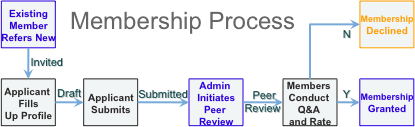
To become a member, an organization needs to be referred to join PWX by an existing PWX member and follow the process shown above. The new organization will get an email invitation pointing to a one-page online application form that they need to fill out. After submitting the form, the applicant will undergo peer review by existing members who decide whether to accept the applicant.
A PWX member has responsibilities and duties to share and learn: review project and membership applications, take part in dialog, and respond to peer requests. The quantity and quality of this effort is what allows PWX (the platform and process) to scale up and manage thousands of projects worldwide.
For its membership growth, PWX uses a peer review process to ensure that new members are personally and/or professionally known to have successful track records, or are ready to commence their first project with support.
To become a member, an organization needs to be referred to join PWX by an existing PWX member and follow the process shown above. The new organization will get an email invitation pointing to a one-page online application form that they need to fill out. After submitting the form, the applicant will undergo peer review by existing members who decide whether to accept the applicant.
How to Participate as an Observer
Without requiring membership, we make it easy for individuals and groups to
become part of a global force to solve the world's water crisis.
Impact assessment is vital to see how many water projects are successful, how they transform the lives of the thirsty, and how they are in turn transformed by the community. Water agencies and specialists do in-depth analysis of the impact of water on health, education, livelihoods, women's status, agriculture, and the local economy. However, it is only possible to conduct such analysis on a tiny fraction of the projects.
We believe that there is a simpler, yet meaningful and valuable assessment that can be done by volunteers to cover a significant fraction of water projects. We seek volunteers to visit projects and let us know if it is working or not, take pictures, video, and interview community members. With the help of volunteers, PWX can track long-term operation and impacts of projects even years after completion, making observers an integral part of PWX bringing projects to life.
Impact assessment is vital to see how many water projects are successful, how they transform the lives of the thirsty, and how they are in turn transformed by the community. Water agencies and specialists do in-depth analysis of the impact of water on health, education, livelihoods, women's status, agriculture, and the local economy. However, it is only possible to conduct such analysis on a tiny fraction of the projects.
We believe that there is a simpler, yet meaningful and valuable assessment that can be done by volunteers to cover a significant fraction of water projects. We seek volunteers to visit projects and let us know if it is working or not, take pictures, video, and interview community members. With the help of volunteers, PWX can track long-term operation and impacts of projects even years after completion, making observers an integral part of PWX bringing projects to life.
How PWX Can Help You
PWX Snapshot
- Communities Assisted: 3267
- Number of Countries: 42
- People Benefited: ~ 1,524,810
- Programs/Projects: 2112 ($52M)
- Projects in Progress: 140
- STPs Tracked (map): 65 (list)
- Community Contribution: 8.9%
- Plans Peer Reviewed: 249 ($11M)
- Peer-Approved Plans - Needing Funds: 26
News Highlights
- Farewell Jin Zidell - A Monumental Figure In Water Jun 16, 2023
- Rain Centre Monitors Chennai's Water Table Mar 18, 2018
- Picture (of) 10 years of connecting WASH people Mar 16, 2016
- Let The Children Lead Bangalore Out Of Its Sewage Mess Feb 26, 2016
- Stopping Sewage from entering Lakes at Kaikondarahalli Kere Habba Jan 09, 2016
Get Involved
- Join PWX and use it to manage your water investment portfolio or make your project history come alive.
- Donate and maximize the impact of your contribution using PWX's peer-review and long-term impact assessment processes.
- Volunteer as a citizen journalist and help verify our progress against the water crisis!
Team
- The team behind PWX
- An interactive logo collage and list combo of the network
- An interactive list of our 136 members.
Contact
© 2006-2020 Peer Water Exchange